


The Forever Chemicals in Your Water: What Platypuses Are Telling Us About PFAS
When Dr. Ian Wright’s research team started testing dead platypuses for PFAS contamination, the lab manager called immediately with an urgent question: “Where the hell is this from?” That moment marked the beginning of a detective story that would reveal uncomfortable truths about what’s flowing through Australia’s drinking water catchments—and into all of us.
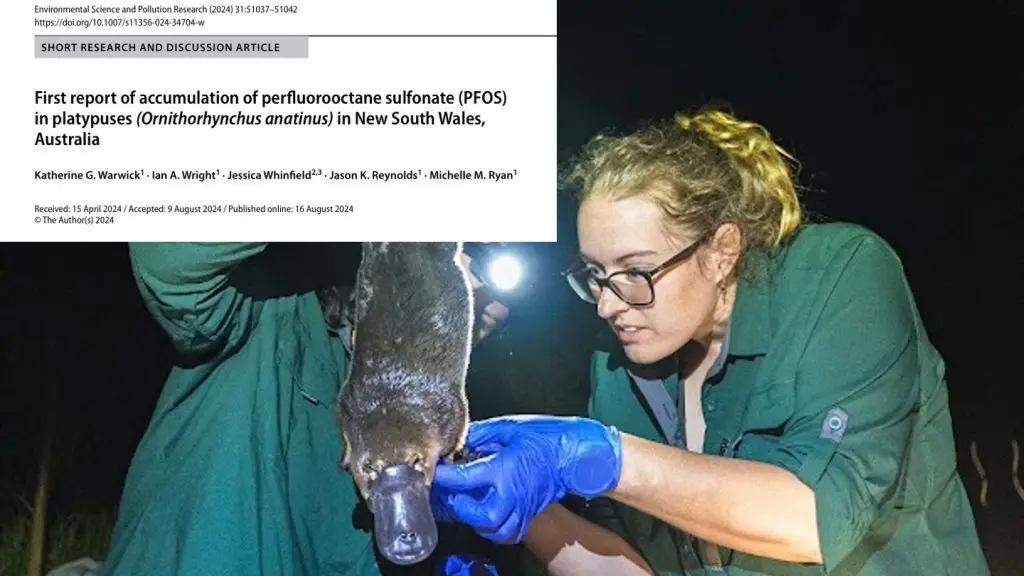
The platypus, it turns out, is the canary in the coal mine for our water supply. And what they’re telling us should make every Australian pay attention.
One Drop in 20 Olympic Swimming Pools Is Enough to Harm You
PFAS chemicals are dangerous at concentrations so dilute they defy intuition. We’re talking about nanograms per litre—one part per trillion. To visualise this: imagine one drop of liquid dispersed across 20 Olympic swimming pools. That’s the scale at which PFAS operates.
Yet even at these infinitesimal concentrations, PFAS bioaccumulates. It builds up in our livers and kidneys the same way it concentrates in platypus tissue, magnifying from barely detectable levels in water to dangerous concentrations in living organisms. The US Environmental Protection Agency now states there is “no known safe level” for certain PFAS compounds in drinking water. Australia’s guidelines? They’re 50 times more lenient than American standards for some PFAS types.
Why it matters: The question isn’t whether Americans are more susceptible to chemical harm—it’s whether Australian guidelines are designed to protect public health or to protect polluters. When your safety threshold is an order of magnitude higher than international standards, you have to wonder whose interests are being served.
The Third Most Contaminated Platypus in NSW Was Found in Sydney’s Water Catchment
When Australia’s Chief Health Officer declared in 2024 that Sydney had “clean catchments” with no PFAS concern, Dr. Wright already knew otherwise. Platypus B—the third most contaminated platypus in the entire state—had been found in the Wingecarribee River at Berrima, which flows directly into the Warragamba catchment that supplies Sydney’s drinking water.
The only platypus tested that had zero PFAS? The one that died of old age in Taronga Zoo, never exposed to the wild waterways the rest of us depend on.
Why it matters: You can’t be certain something isn’t there if you don’t test for it. For years, Sydney Water monitored PFAS in sewage and sewage solids but not in drinking water. When they finally started testing in 2024, they discovered the Upper Blue Mountains water supply was among the most contaminated large water sources in Australia—with PFAS levels double the Australian guideline and four times the US standard.
A Single Truck Crash 34 Years Ago Is Still Poisoning a Water Supply Today
In 1992, a petrol tanker overturned near the Hydro Majestic Hotel in the Blue Mountains and caught fire. First responders used PFAS-containing firefighting foam to suppress 40,000 litres of burning fuel. The foam ran down a small creek and into the reservoir system.
When Dr. Wright sampled that drainage in 2024—more than three decades later—he found PFAS concentrations of 2,300 nanograms per litre. The US EPA recommends less than 4. The contamination is tens of thousands of times higher than safe levels, persisting in the environment from a single incident that happened before many current residents were born.
Why it matters: PFAS chemicals are called “forever chemicals” for a reason—they don’t break down. One emergency response decision made in 1992 has exposed an entire community to contaminated drinking water for over 30 years. Families who moved to the Blue Mountains in the 2000s and 2010s unknowingly raised their children on this water, and PFAS impacts are most severe on developing bodies and brains.
“He actually explained that it helped him to know that his PFAS was high because there are measures you can take to reduce PFAS levels… but the community, I’ve actually never dealt with that sort of emotion before. Part of it is anger about the information and the denial of blood testing for them.”
River Foam Is Concentrating PFAS and Metals Into a Toxic Cocktail
When citizen scientist Frances Retallack saw unusual foam on the Belubula River near Orange, she did something researchers wouldn’t have thought to do—she scooped it into an esky and had it tested. The results were shocking.
The PFAS concentration in the river water measured 20-30 nanograms per litre. In the foam? An average of 375,000 nanograms per litre—a concentration factor of more than 10,000 times. The foam was also grabbing metals from the water: copper levels jumped from 3 micrograms in the river to 2,900 micrograms in the foam.
Through a process called foam fractionation, the bubbling and turbulence of the river naturally concentrates PFAS onto bubble surfaces, creating toxic foam that accumulates along riverbanks—exactly where livestock drink and children play.
Why it matters: If cattle drink water with just 3 nanograms of PFAS throughout their lives, their meat will fail European Union export guidelines. The Belubula River typically runs at 9-10 times that level. A cow drinking from foam-contaminated sections could receive a lifetime’s worth of PFAS exposure in a single hot day when it might consume 100 litres of water. And the most contaminated Murray Cod caught in that river? Eating just 10 grams—one forkful—would give you your entire daily PFAS limit.
It’s Already in All of Us—And We’re Not Being Allowed to Find Out How Much
Thanks to Australian Bureau of Statistics health surveys, we know PFAS is building up in the blood of all Australians. Concentrations increase with age and are slightly higher in males (monthly menstrual blood loss actually reduces PFAS levels in females). We’re all walking bioaccumulators.
Yet when communities exposed to high PFAS levels request blood testing, they’re routinely denied. A single PFAS blood test costs around $500 and isn’t covered by Medicare or private health insurance. In the Blue Mountains, where residents have been drinking contaminated water for decades, NSW Health refused blood tests despite community pleas—a response that stands in stark contrast to American practice, where blood testing is standard for exposed populations.
Why it matters: Without blood testing, exposed communities can’t establish baseline contamination levels, can’t link health symptoms to PFAS exposure, and can’t hold polluters accountable. The refusal to provide accessible testing looks less like public health policy and more like liability management. When you’re told your water is safe but denied the test that would prove it, trust evaporates.
Looking Forward: The Uncomfortable Truth
Dr. Wright asks a question at the beginning of his presentation: “Is PFAS under control?” By the end, the answer is clear—and it’s not comforting.
We don’t fully understand PFAS impacts. We don’t know how to remove it from the environment. It’s not routinely monitored in waterways, drinking water, or food supplies. Government websites provide scattered, siloed information while volunteer organisations like Friends of the Earth do the work of aggregating contamination data. Journalists and citizen scientists are uncovering contamination that authorities either didn’t look for or didn’t disclose.
The science for action exists—when Sydney Water discovered the Blue Mountains contamination, they installed filtration systems within months and successfully reduced PFAS to acceptable levels. The technology works. What’s missing isn’t capability; it’s transparency, monitoring, and political will.
The platypuses are sending us a message from the rivers we depend on. The question is whether we’ll listen before the contamination becomes impossible to ignore—or to fix.