
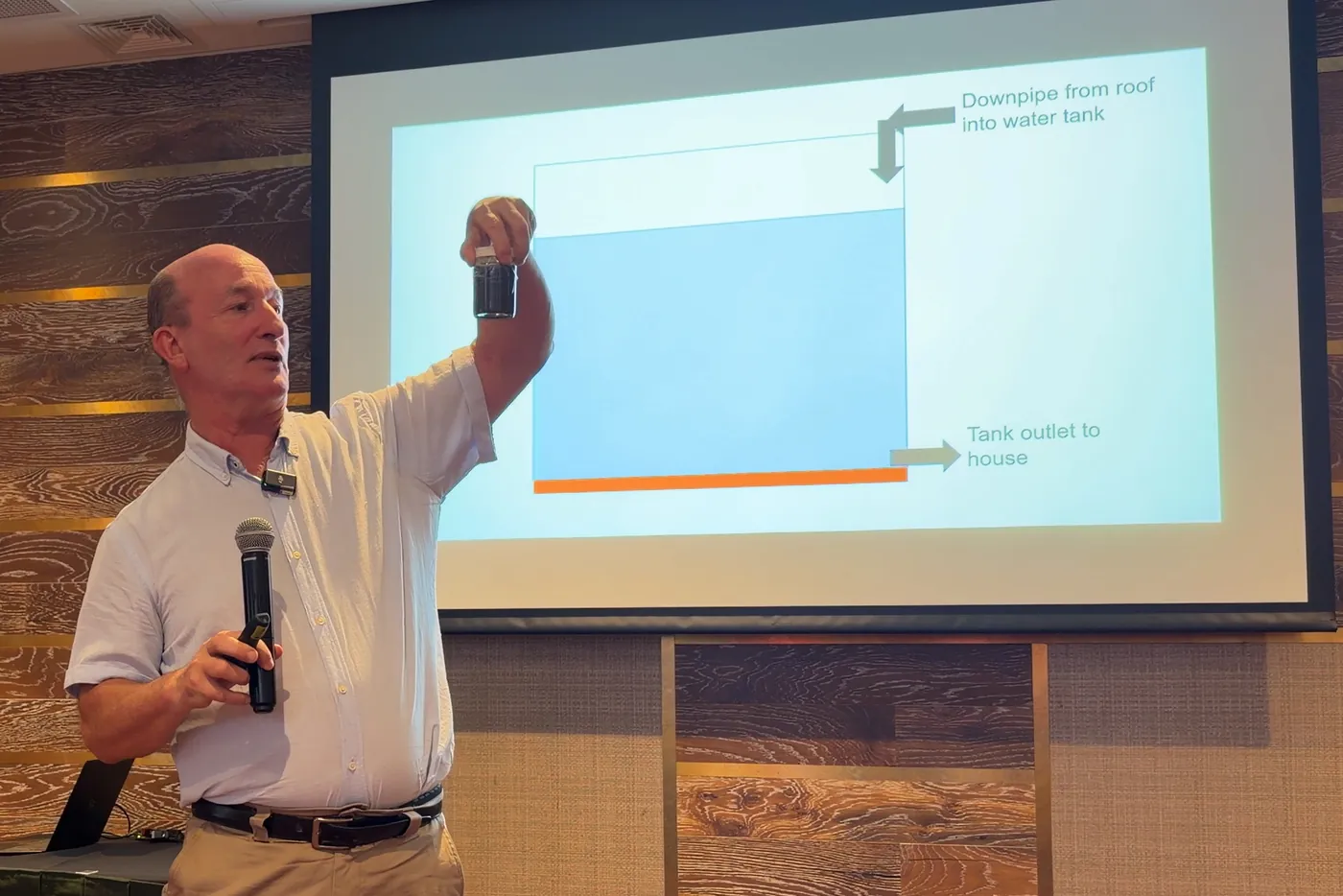
Thank you to everyone who came to Mittagong RSL on Thursday night to hear Dr Ian Wright, Associate Professor at Western Sydney University, present the results of his rainwater tank testing, and to the households who let Ian and his team test their tanks.
Rainwater tanks in the Southern Highlands hold the most acidic water of the four NSW regions the team tested. That puts local homes in the high-risk range for lead and copper leaching from pipes and fittings.
The team has now sampled 260 tanks, including 68 in the Southern Highlands, in what Ian described as the most detailed study of its kind in Australia.
Watch the talk
 Is Your Tank Water Safe? Rainwater Tank Testing in the Southern Highlands | Dr Ian Wright
What the tests found
Lead is the main concern. Most other metals build up in the sediment at the bottom of tanks, close to the outlet, but were low or undetectable at the kitchen tap.
- Lead: 86.8% of Southern Highlands tank-bottom samples failed the Australian Drinking Water Guidelines (below 5 µg/L). Six of 10 kitchen-tap samples from local homes reached or exceeded the guideline; the highest was 94 µg/L.
- Manganese: 64.7% of tank-bottom samples failed (guideline below 100 µg/L). All tap samples were below the guideline.
- Nickel: 23.2% failed (below 20 µg/L). All tap samples were below.
- Arsenic: 17.6% failed (below 10 µg/L). All tap samples were below.
- Cadmium: 10.3% failed (below 2 µg/L). All tap samples were below.
- Copper: no samples failed (below 2,000 µg/L).
“Lead, though, worries me more,” Ian said. He said the local lead results should be shared with Wingecarribee Shire Council’s environmental health officers, and he plans to return to test more taps.
PFAS was found in 55.8% of local tanks, but at very low levels. “I’m not concerned about PFAS here in the Southern Highlands,” Ian said.
Why our tank water is high risk
Local tank water is very pure, soft and acidic, so it attacks metal pipes, solder and fittings. “Southern Highlands tank water was the most acid in our study,” Ian said.
- pH is about 5.5, well below the 6.5 risk threshold. Because pH is logarithmic, that is ten times more acidic.
- Alkalinity is almost nil, so there is nothing to buffer the acid.
- Salinity is very low, which makes water more aggressive.
- No chlorine or phosphate: town supplies add these; tank water has neither.
- Temperature: water above 24°C is in the high-risk range, so the risk rises over summer.
“I’m sorry to say … you’re in every high-risk range,” Ian told the forum. Sources of lead on a property include roof flashing, solder, lead-headed roofing nails and washers. Copper leaches from household copper pipes, particularly when water sits in them for hours.
What you can do if you drink tank water
“That’s my biggest message: filter, filter,” Ian said. “You don’t need to have a multi-thousand-dollar water filter to have safe drinking water.”
- Filter water for drinking and cooking. A basic filter is enough. In a university trial, a simple 7-micron paper filter cut lead from about 2,000 µg/L to 3 µg/L. Gravity filters work well because they don’t clog. There’s no need to filter water for toilets or the garden.
- Flush your pipes. Run the tap for at least a minute first thing in the morning, and for several minutes if you’ve been away.
- Don’t drink discoloured water. Sediment can be stirred up by a water delivery or a summer storm. If the water changes colour, don’t drink it. Take a photo, note the date and time, and if you can, keep a sample in the fridge for testing.
- Deal with the sediment. Have the tank cleaned or the sediment pumped out. The sludge is concentrated pollution, so keep it well away from children and vegetable gardens.
- Keep the roof catchment clean. Clean gutters and leaf guards regularly and consider a first-flush diverter.
Boiling tank water kills bacteria and viruses but does not remove metals. Private water testing is available through commercial laboratories.
About the study
The Western Sydney University team has tested 260 rainwater tanks in four NSW areas: the Southern Highlands (68 tanks tested for metals, 43 for PFAS), Cadia near Orange (79 and 45), Narrabri (42) and Mendooran (47). Two papers have been published, and the Southern Highlands results are now going through peer review.
Read more about WinZero’s work on river health.